Stranded Wire Versus Solid: Flexibility Where It Counts
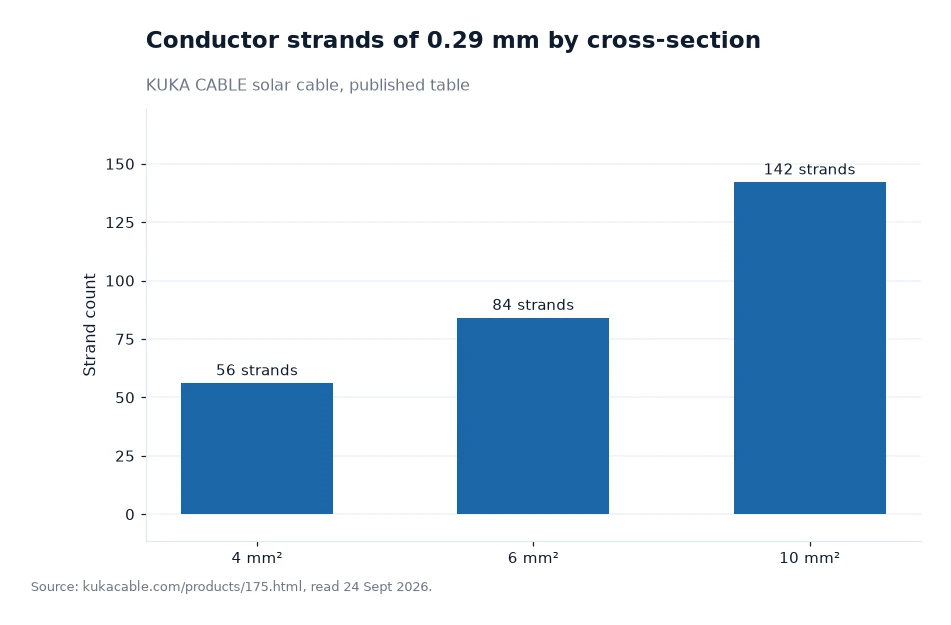
A solid conductor is one thick core; a stranded conductor is the same metal split into many fine wires. KUKA CABLE publishes its small PV sizes as class 5 stranded copper, with 56 strands of 0.29 mm at 4 mm², 84 strands at 6 mm² and 142 strands at 10 mm², and that construction is decided by movement on the roof rather than by a wish to save copper.
Key takeaways
- Strand counts on the manufacturer's table run 56 × 0.29 mm at 4 mm², 84 at 6 mm² and 142 at 10 mm².
- Nominal overall diameters for those sizes are 5.5 mm, 6.0 mm and 7.5 mm, and the published bend limit is four times the outer diameter.
- The conductor is described as tinned copper, class 5 flexible to IEC 60228, a stranding class meant to be moved and re-terminated.
- Elongation before ageing is listed at 125% or more, while the maker states its PV designs typically reach up to 185%.
Why a roof is hard on a stiff core
A PV array is not a static object. Module frames warm and cool through the day, mounting rails shift by millimetres, and every service visit ends with a cable pushed aside, re-clipped or re-terminated. One thick core takes that movement as bending stress concentrated along a single axis, so the outside of the bend carries most of the strain. A bundle of 56 thin wires spreads the same bend across many small surfaces, and each individual wire sees far less strain than a solid core of the same nominal size.
The published test list reflects that reality. It includes a cold bending test and a cold elongation test alongside tensile testing after ageing. Those checks matter most in winter installations, where a stiff compound cracks instead of yielding, and they are run on finished product rather than on a laboratory sample.
There is a second reason the stranding question comes up on service calls. Roof work rarely happens on a still day, and a cable that has to be pulled, dressed and clipped in cold weather is being asked to bend more than once. A conductor built from many small wires returns to shape after that handling; one thick core keeps the memory of every kink, and the next installer works around the bend that was left behind.
What the strand table shows
The manufacturer's cross-section table pairs every nominal size with a strand construction, an overall diameter and a weight per metre. The small sizes are built from 0.29 mm strands; from 95 mm² upward the same table switches to 0.39 mm strands, which keeps the strand count workable inside a thick conductor. Insulation is listed at 0.7 mm and the sheath at 0.8 mm for the 1.5 mm² to 10 mm² sizes.
- The strand list is given as tinned copper, so each fine wire carries its own corrosion protection.
- The 1500 V product page describes insulation and sheath as XLPO, electron-beam cross-linked and LSHF.
- The finished cable is spark tested at 10 kV during production and pressure tested at 6.5 kV AC for five minutes.
Flexibility and insulation are settled at the same time. A stranded core is easier to route round a tight corner, and a flexible cross-linked compound follows it without whitening or splitting at the bend. Buy a stiff core with a stiff compound and the corner becomes the place where the sheath fails first.
Bend radius: the number to check first
The published bending radius is four times the outer diameter. Using the diameters from the same table, a 4 mm² cable would need a minimum radius of about 22 mm, a 6 mm² about 24 mm and a 10 mm² about 30 mm. That is my own multiplication of two published numbers, not a figure the site prints. An installer who pulls the cable round something tighter is relying on luck, and the damage usually appears months later as a crack in the sheath.
The maker's solar wire range is listed against TUV 2PfG 1169/08.2007, EN 50618:2014 and IEC 62930. Those documents govern the compound, the temperature range and the ageing tests. Class 5 stranding is what allows the finished product to meet them on an installation that is not perfectly straight, and the published test list shows how the results are checked. A drum that passes those tests still depends on the person dressing it: the certificates cover the cable, not the corner it is pulled round.
Where a solid core still has a case
Solid conductors stay sensible in fixed, protected work: switchgear links, busbars, straight conduit where nothing will be moved and terminations are made once and left alone. String wiring on a roof is the opposite case. It is fixed to a rail that moves, it is re-terminated when a connector is replaced, and it is often coiled and uncoiled on site before it is clipped down.
The published environment adds thermal movement to the mechanical movement: ambient from −40 °C to +90 °C, and short-circuit excursions up to +250 °C for five seconds. A conductor that cannot follow those changes without local stress has a shorter working life than one that can, whichever nominal cross-section the two of them share.
The numbers behind the sizes
| Nominal cross-section | Conductor construction | Nominal overall diameter | Nominal weight |
|---|---|---|---|
| 1.5 mm² | 39 × 0.25 mm | 4.6 mm | 34 g/m |
| 2.5 mm² | 49 × 0.25 mm | 5.0 mm | 45 g/m |
| 4 mm² | 56 × 0.29 mm | 5.5 mm | 59 g/m |
| 6 mm² | 84 × 0.29 mm | 6.0 mm | 78 g/m |
| 10 mm² | 142 × 0.29 mm | 7.5 mm | 130 g/m |
Worked example
Suppose you want to know how much metal sits inside that 4 mm² construction. Treating each strand as a circle of 0.29 mm diameter, the area is π × (0.145 mm)², which is about 0.066 mm². Multiply by 56 strands and the answer is roughly 3.70 mm². That calculation is mine: it assumes the published 0.29 mm is the strand diameter and that the strands are round. It also explains why a nominal 4 mm² class 5 conductor holds visibly less copper than the nominal figure suggests.
The same method on the other rows gives about 5.55 mm² for the 84-strand design and about 9.38 mm² for the 142-strand design. If a project is sensitive to copper area rather than to nominal size, ask for the measured conductor resistance on the inspection record instead of working backwards from the strand count.
Frequently asked questions
Does a stranded conductor carry less current than a solid one of the same nominal size?
Current capacity follows the copper area and the permitted temperature, not the way the copper is arranged. What does change is geometry: round strands leave gaps, so a nominal 4 mm² design holds roughly 3.7 mm² of metal by my own area calculation. The figures worth checking on the datasheet are the rated DC 1.8/1.8 kV and the published ambient range of −40 °C to +90 °C.
Can a 4 mm² PV cable be bent by hand at a connector?
Hand bending at a connector is normal practice. The published limit is a radius of four times the outer diameter, which for a 4 mm² cable of 5.5 mm diameter comes to about 22 mm by my own multiplication. Leave the first bend a hand's width back from the crimp so the connector body carries no load, then clip the cable so the corner cannot be pulled tighter later.
What to ask the supplier
Ask for the strand construction and the conductor class in writing, together with the finished diameter, the weight per metre and the measured conductor resistance. The manufacturer's site does not publish prices, minimum order quantities or lead times, so those questions belong in the enquiry rather than in an assumption. If the run sits on a tracker or any structure that moves, say so and ask which cold bending and cold elongation results apply to the size you are buying. The KUKA CABLE company site lists the contact address in Jinshan District, Shanghai, if the enquiry needs to go to the factory directly.
Strand counts used in this comparison are the manufacturer's own website figures, which I dated 24 Sept 2026[1].