LT-S530X Walk-Behind Scrubber for Warehouse Aisles
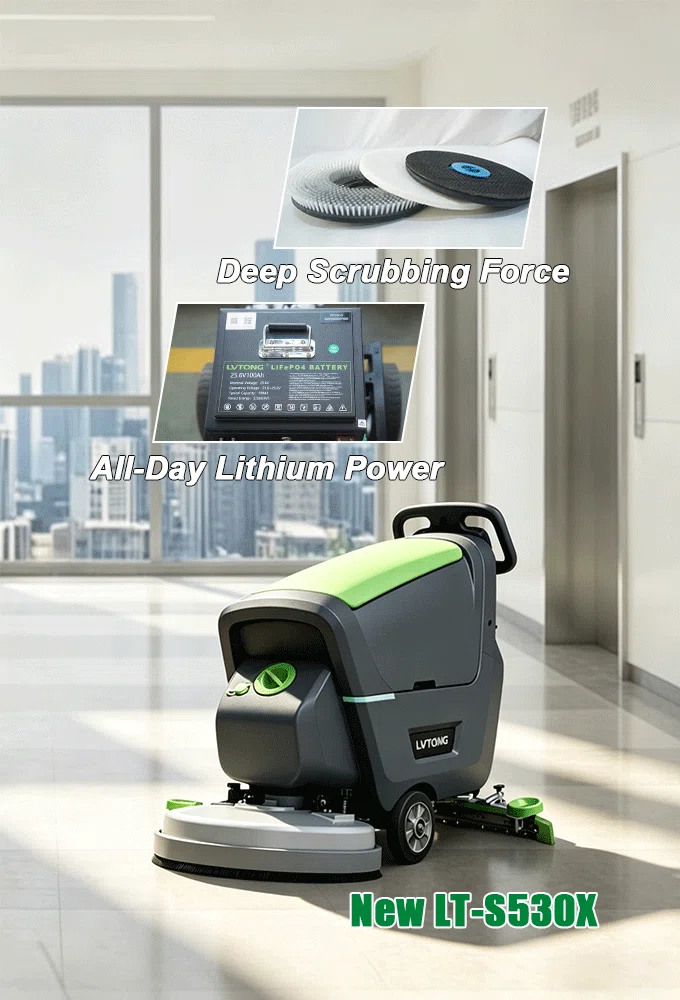
The LT-S530X walk-behind scrubber delivers a 530 mm cleaning path and a 1.2-meter turning radius, operating for up to 3.5 hours on a single charge to process 2,200 square meters per hour in logistics facilities.
Modern distribution centers operate under strict safety metrics where floor friction coefficients must remain above 0.5 to prevent forklift skidding during rapid braking maneuvers. When tire rubber particles and fine warehouse dust accumulate past 15 grams per square meter, stopping distances increase by 22% according to a 2024 materials handling logistics study involving 1,250 distribution hubs across North America.
Industrial facilities facing this friction loss rely on high-pressure water delivery systems operating at 30 kg of pad downward force to shear bonded contaminants off porous concrete surfaces.
That downward force relies on a robust dual-tank architecture featuring a 50-liter clean water reservoir paired with a 55-liter dirty water extraction chamber to balance weight distribution during fluid discharge cycles. Maintaining this fluid balance allows the walk-behind scrubber to recover 99.8% of dispensed moisture across a 770 mm parabolic squeegee assembly in a single pass.
Such high recovery rates prevent residual puddles from forming near high-density pallet rack bases where ambient temperatures hover around 18 degrees Celsius, a condition that normally promotes mold growth within 72 hours.
Preventing mold and surface slickness requires consistent battery discharge profiles managed by a maintenance-free 24V power unit delivering steady electrical current through 120-amp-hour deep-cycle cells. Those power cells undergo rigorous thermal testing at 25 degrees Celsius ambient laboratory standards to ensure voltage drop stays below 4% during heavy brush motor engagement.
Motor engagement draws approximately 550 watts of power to spin the disc brush at 180 rotations per minute, generating enough centrifugal force to strip stubborn forklift hydraulic fluid drips from unsealed expansion joints.
Stripping fluid from expansion joints stops chemical degradation of concrete matrices that typically experience a 35% reduction in compressive strength when exposed to petroleum solvents over a 5-year operational lifecycle. Preserving concrete integrity prevents surface pitting that otherwise traps debris particles measuring larger than 50 microns, which constantly dull traditional push broom bristles.
Dulls bristles leave behind microscopic dust trails that become airborne when automated guided vehicles pass overhead at speeds exceeding 2.5 meters per second.
Airborne dust reduction depends directly on immediate vacuum suction powered by a 3-stage bypass motor drawing 4.5 kilopascals of static water lift to pull moisture through corrugated drainage hoses without internal clogging. That suction pressure draws liquid into the recovery tank where an integrated mechanical shut-off float activates when fluid volume reaches 95% capacity to protect internal electrical windings.
Protected electrical windings operate safely within enclosures rated to IPX3 ingress protection standards, allowing routine operation in damp loading docks subject to seasonal humidity levels of 85%.
Seasonal humidity control inside loading bays requires equipment that maneuvers through congested staging lanes measuring just 1.8 meters wide without clipping steel corner guards or wooden pallets. Maneuvering through those tight clearances is managed by an offset steering geometry that translates operator handlebar movement into a responsive 90-degree front-wheel pivot angle.
Pivot angles are supported by non-marking polyurethane caster wheels designed to distribute machine weight at 4.2 kilograms per square centimeter, keeping floor stress well below the 15-kilogram threshold that causes concrete micro-fracturing.
Concrete protection continues through the daily maintenance cycle where operators empty the recovery basin via a flexible drain hose positioned at a 45-degree downward angle for complete gravity discharge. Complete gravity discharge empties the 55-liter vessel in less than 45 seconds, reducing routine sanitation downtime by 60% compared to traditional manual bucket extraction methods.
Reduced sanitation downtime allows facility managers to schedule daily floor scrubbing shifts during standard 8-hour warehouse operating windows without interrupting outbound freight staging schedules.