Checking the 'In-House' Claim: A Compounding and Filling Scope List
In-house is the most repeated and least defined phrase in fragrance manufacturing. It can mean a company weighs its own aroma materials, or it can mean a company owns a licence and a customer list while two other plants do the work. The difference matters for an EU-bound project because it decides how many handovers sit between your brief and your documents. This scope list turns the claim into a set of questions with observable answers, so the verification takes a meeting rather than a leap of faith.
Key takeaways
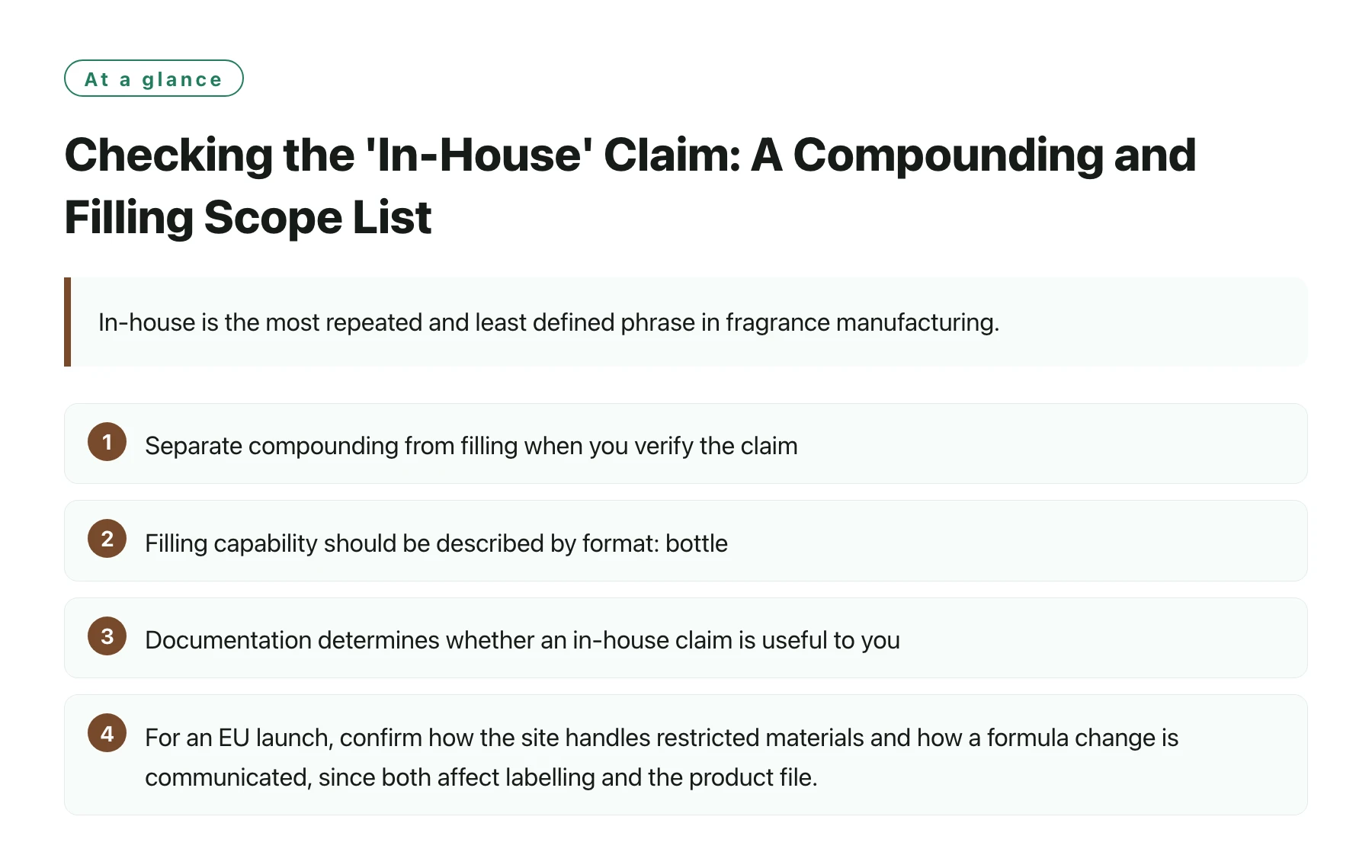
- Separate compounding from filling when you verify the claim, because many suppliers own one and subcontract the other.
- Filling capability should be described by format: bottle, pump, crimp, roller, travel size and refill each need different equipment and checks.
- Documentation determines whether an in-house claim is useful to you, because the value of owning the process is the ability to explain and evidence it.
- For an EU launch, confirm how the site handles restricted materials and how a formula change is communicated, since both affect labelling and the product file.
The reason the in-house question keeps coming up is that it is a reasonable proxy for something real. A supplier that compounds, fills and documents on one site usually has fewer places for a technical answer to get lost, and fewer parties to coordinate when a launch date moves. That is a genuine advantage, and it is worth checking rather than assuming.
This checklist is written for a product development or technical sourcing role that has to justify a choice internally. It is organised by the four capabilities that the phrase in-house usually bundles together, and it pairs each one with the evidence that settles the question.
It is deliberately practical. Nothing on the list requires a laboratory visit to evaluate, and most of it can be resolved with two documents and one video call, which is a useful property when candidates are on another continent.
The four capabilities hidden inside an in-house claim
| Capability | What to verify | Evidence that settles it |
|---|---|---|
| Aroma material handling | Whether materials are received, verified and stored on site under controlled conditions | Incoming inspection records for aroma materials, with lot numbers and storage conditions |
| Compounding | Whether the concentrate is weighed and blended at the site you are visiting, by trained staff, against a written formula | A redacted batch record showing weighing, mixing and the second-person check |
| Filling and packing | Which formats the lines actually run, and which are sent out, including pumps, crimps and refillable shells | A filling capability list with the formats and the pack components qualified for each |
| Quality and documentation | How the finished product is tested and released, and who maintains the specification and its revisions | A certificate of analysis for a comparable product, plus the change procedure that governs it |
A supplier can legitimately own three of these four and still be a good partner. What matters is knowing which one is missing, because that is where your project's handover points will be.
Why compounding is the capability worth confirming first
Compounding is where the formula becomes physical, and it is the step most often outsourced by companies that describe themselves as manufacturers. The work itself is straightforward to describe: measure materials against a written formula, blend them in a defined order under defined conditions, and check the result against a reference. The complexity sits in the accuracy of the weighing, the cleanliness of the process and the consistency of the record.
There is a technical reason to care about who performs this step. The interaction between aroma materials and the base can shift colour, clarity and odour over time, and small deviations in weighing are invisible in a single bottle and obvious across a production run. Formulation science is a serious discipline in its own right, and the literature on how components behave in a matrix is a fair indication of how much can change with a small process difference [1].
There is also a commercial reason. If compounding sits outside the relationship, then every formula question travels to a third party, and the answers that determine labelling and the safety assessment arrive second-hand. A brand can manage that, but it should price the additional coordination into its planning rather than discover it during artwork approval.
A practical question that separates the two structures: ask which person would handle a revision to a restricted material, and whether that person is employed at the filling site. The answer is usually unambiguous.
A verification sequence that fits into one meeting
- Ask for the production path in one pageCompounding site, filling site, decoration, warehouse. A short document is harder to keep vague than a conversation.
- Request one redacted batch recordLook for the formula reference, the weighing record, the second-person check, the fill values and the release signature. Its completeness matters more than its polish.
- Ask for the format list rather than the machine listFormats are what you buy. A list that mentions bottles, pumps, crimps, rollers and refillable shells tells you whether your pack is routine or novel for the site.
- Test the change procedure with a scenarioDescribe a material substitution and ask what happens to the specification, the retained sample, the label and the file. Listen for a sequence rather than an assurance.
- Confirm what is subcontractedGlass, decoration, cartons, testing and freight are commonly external. Naming them is a sign of confidence, and it gives you the list of handovers to manage.
- Ask who signs the handoverOne name per handover point, with a documented check on each side, is the difference between a chain and a gap.
The parts of the scope that an EU launch adds
For a fragrance placed on the European market, the scope question acquires a regulatory edge. Restricted materials have concentration limits that depend on the product type, and those limits are maintained in the ingredient database that suppliers and assessors both work from. A compounding site that checks materials on receipt and again at bulk release is not being fussy; it is protecting the claim that your label makes.
Ownership is the second addition. A formulation can be protected in more than one way, and a brand entering a development agreement should understand which parts of the work it will hold and which it will license. Intellectual property questions in fragrance development are a normal part of commercial negotiation rather than a sign of distrust, and the framework for them is well established [2].
The third addition is evidence discipline. Because the value of an in-house scope is precisely the ability to explain and evidence a process, a supplier that cannot produce a comparable record has not really delivered the benefit it claims. That is why this checklist puts documentation alongside compounding rather than underneath it, and it is why a claim such as custom fragrance R&D and production is worth testing with a document request rather than a facility photograph.
Where the process is genuinely integrated, the effect on a launch is visible in the small things: a faster answer to a compatibility question, a same-week confirmation that a pack component is qualified, a revision that reaches the label before artwork is signed. Those are modest advantages individually and significant in aggregate across a first order.
Reading the answer you receive
Suppliers that own their process answer the scope questions concretely and without defensiveness. Their descriptions include the step order, the checks and the names of the roles involved. When they subcontract something, they say so, because they know the boundary is normal.
Suppliers that coordinate answer differently. The reply tends to describe capabilities in the aggregate, use the word partner for other companies, and require a follow-up for anything specific. That is not automatically a disqualification, and for unusual packaging it can be the better route. It does mean the scope claim should be discounted, and the coordination cost should appear somewhere in the plan.
One test is worth running before a shortlist closes. Ask both types of supplier to walk you through the same sequence, from formula to finished bottle, and note which one can answer without consulting anyone. A single integrated partner, such as a manufacturer that keeps R&D and manufacturing in one place, will typically describe the whole chain in one voice. Also worth knowing before you commit is how far a supplier will support a fully bespoke fragrance development and production route, since that answer decides how much of the formula work stays yours.
Whichever answer you receive, write it down. A verified scope is a working document during the project, and the note you take in the evaluation meeting becomes the reference you use when a handover point is questioned six months later.
Materials themselves deserve the same scrutiny, because the limits that govern their use are set by category and reviewed over time [3]. A supplier that tracks those limits as part of its compounding practice is doing compliance work, not just manufacturing work.
Sources
- Chemistry World (Royal Society of Chemistry) —— The Royal Society of Chemistry's magazine, covering chemistry research and explanations of everyday materials including aroma compounds.
- WIPO — World Intellectual Property Organization —— The UN agency for intellectual property; resources on industrial design and patent protection relevant to product and packaging design.
- IFRA: Safe Use and Fragrance Science —— IFRA's explanation of how fragrance materials are scientifically assessed for safe use and how those conclusions are applied by the industry.
Frequently asked questions
Does in-house compounding make a fragrance supplier better?
Not automatically, but it changes the shape of the project. Integrated compounding usually shortens technical exchanges and reduces handovers, while a coordinating supplier may offer wider packaging and smaller minimums.
How can I verify an in-house claim from another country?
Ask for a redacted batch record, the production path in writing and a video walkthrough of the compounding and filling areas. Two documents and one call normally resolve the question.
What if a supplier subcontracts filling but compounds on site?
That is a common and workable arrangement. The practical task is to identify the handover point and confirm who checks the goods and who holds the records on each side.
Which format is hardest for a factory to add?
Refillable and travel formats usually require more pack qualification and leak testing than a standard spray, and crimp or pump variations may need different tooling. Ask before the pack is decided.
Do I need a factory visit to confirm scope?
Not necessarily. A video walkthrough that includes the compounding area, the filling line and the retained sample store answers most of the checklist, and a visit adds confidence where the project is large.