A Closer Look at Planning quality checks for medical consumables
The phrase medical consumables covers products with very different risk profiles: some are general supplies, while others are regulated medical devices or components used in a clinical procedure. A useful quality plan starts by identifying the exact product, intended use, buyer market, and acceptance evidence. It then links each risk to a supplier control, incoming check, record, and decision owner. This makes inspection more meaningful than applying one generic checklist to every carton.
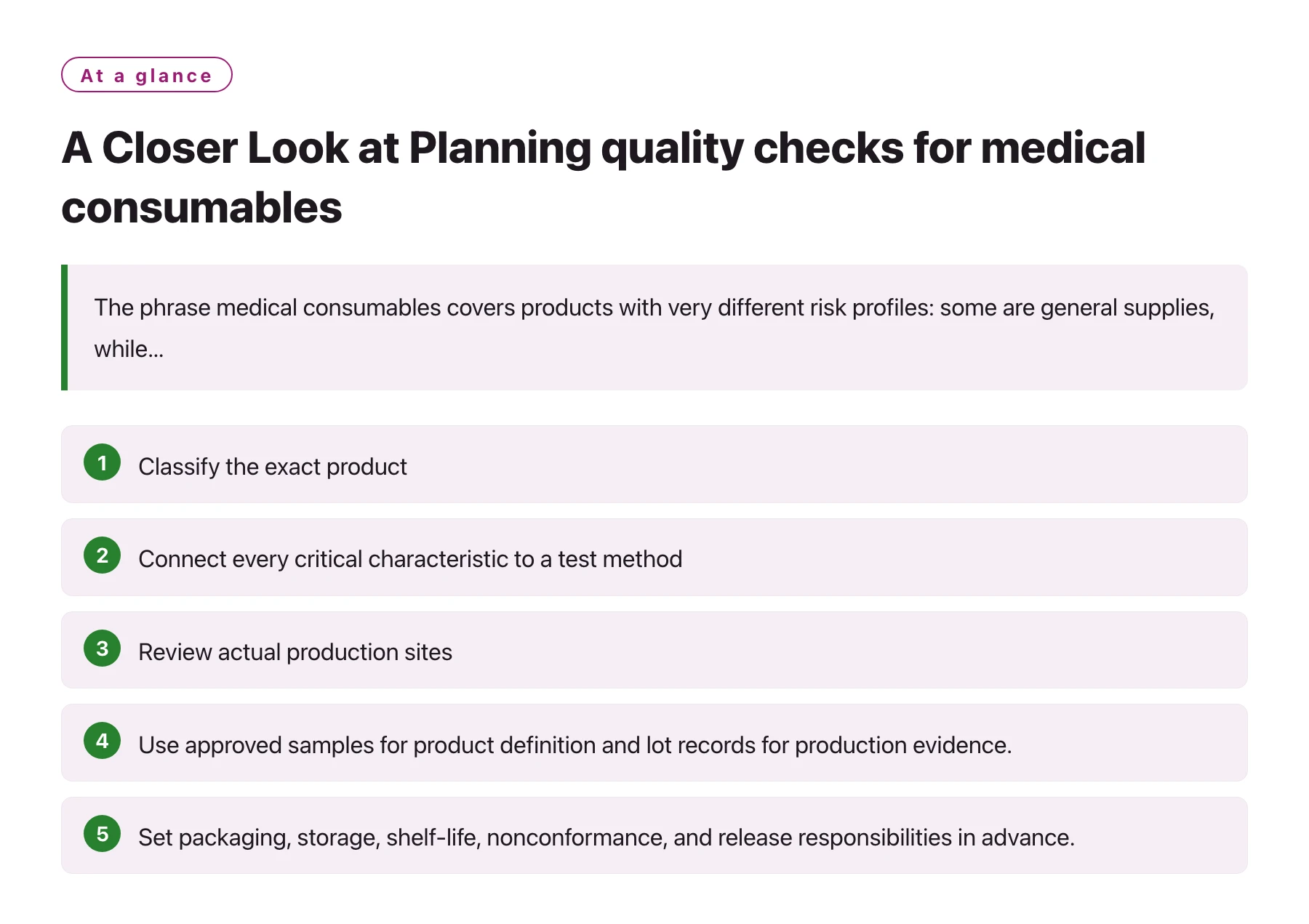
Key takeawaysClassify the exact product, intended use, and destination market before selecting a checklist. · Connect every critical characteristic to a test method, sampling basis, and retained record. · Review actual production sites, subcontracted processes, lot traceability, and change controls. · Use approved samples for product definition and lot records for production evidence. · Set packaging, storage, shelf-life, nonconformance, and release responsibilities in advance.
A quality check is useful when it can support a clear decision: accept, hold, investigate, or reject. The plan should explain what is checked, against which revision, by whom, and what evidence is kept. Medical supply categories differ, so buyers should adapt these controls to the item, market, and risk rather than copy requirements from an unrelated product.
Start with product identity and intended use
Create a controlled item description before asking a factory to quote. Record the common and technical name, material, dimensions, configuration, packaging level, sterile or non-sterile status, intended use, and any model or catalog identifier. Include product drawings or approved reference samples when words alone could permit materially different interpretations. If a product is sold under multiple labels or private-label variants, identify which artwork and item code belong to this purchase.
Classify the item for the destination market. A disposable drape, a diagnostic accessory, and a device component may trigger different controls even if all are called consumables in a purchasing system. Confirm who is responsible for regulatory classification and market-specific review. Do not infer the classification from a supplier brochure or from the fact that a similar item is already sold somewhere else.
For products intended for the U.S. market that qualify as medical devices, FDA says its Quality Management System Regulation became effective on February 2, 2026, amending 21 CFR Part 820 and incorporating ISO 13485:2016 by reference.[1] That statement concerns the device quality-system framework; it does not mean every item described commercially as a medical consumable is automatically subject to the same device requirements. Ask the responsible regulatory specialist to determine the product’s status and the requirements for the specific transaction.
Translate risks into observable acceptance criteria
For each critical characteristic, specify the limit, method, sampling basis, and record. Examples may include dimensions, tensile or seal strength, material identity, visual defects, labeling legibility, package integrity, or performance under a defined condition. Use only tests that make sense for the product and risk. A check that a label is present does not establish that its content is correct; a visual check of a pouch does not establish that a sterile barrier remains intact.
Separate critical, major, and cosmetic characteristics so inspection effort follows the consequence of failure. Define what counts as a defect and provide photographs or diagrams for subjective appearance criteria. If the method depends on calibrated equipment, trained operators, environmental conditions, or a particular fixture, document those details. Agree in advance how borderline results, retests, and discrepant measurements will be handled.
A supplier may propose its routine process controls, but the buyer should map them to the purchase requirements. Ask for the test method, frequency, acceptance limit, lot definition, and retained evidence. If the supplier’s method differs from the buyer’s proposed check, compare what each method can detect before approving the alternative.
Review the supplier’s production and change controls
Assess whether the actual manufacturing location and process match the supplier’s description. Identify subcontracted steps such as molding, coating, sterilization, printing, packaging, or testing. Confirm which organization controls each step and who is responsible for releasing the finished lot. A business certificate or quality-system certificate may help establish context, but it does not by itself demonstrate that a particular shipment meets the agreed product specification.
Ask how incoming materials are identified and approved, how production records link to the finished lot, how nonconforming items are segregated, and how corrective actions are documented. Where relevant, request a process flow, control plan, sample inspection record, or evidence that the stated production site performed the work. Review the scope and validity of certificates directly with the issuing body when they are important to the decision.
Agree on advance notification and approval for changes to materials, tooling, manufacturing site, subcontractors, process parameters, packaging, artwork, or test methods. A seemingly minor change can alter fit, performance, shelf life, or regulatory status. Require the supplier to identify affected lots and documents, explain the reason, and wait for an authorized buyer decision before implementing changes that require approval.
Use samples and lot records to answer different questions
An approved sample is useful for confirming appearance, dimensions, labeling, and workmanship, but it represents only the sample examined. Define whether it is a visual reference, an engineering sample, or a fully tested qualification sample. Record its date, version, test results, and approval signatures; retain it under conditions that prevent degradation. If the item is sterile or has a limited shelf life, use suitable packaging and handling controls for retained samples.
For production lots, set a traceability scheme that connects raw material or component lots, manufacturing dates, inspection results, packaging identifiers, and shipment cartons. Ask what records are retained, for how long, and how quickly the supplier can trace affected units. When a product has a lot or serial number, test the path from a finished unit back to its production record during supplier qualification rather than assuming the system works.
Choose an incoming sampling plan appropriate to risk, order size, and the available evidence. Sampling can reveal patterns but cannot prove that every unit is defect-free. If a failure could create a serious safety or compliance concern, define escalation and containment steps rather than relying on a larger sample alone. Document who may release, reject, sort, or request replacement for a lot.
Protect packaging, storage, and shelf-life conditions
Packaging is part of the product when it protects cleanliness, sterility, moisture sensitivity, or physical integrity. State pack configuration, seals, protective materials, label fields, language, symbols, carton markings, and any tamper evidence that the buyer requires. Approve controlled artwork and check production proofs against the correct revision. Confirm that shipping cartons can withstand the planned handling and transport conditions.
If the product has a claimed shelf life, request the evidence and date coding basis relevant to that claim. Set a minimum remaining shelf life at delivery only when the purchasing program needs it, and make the calculation point clear. Specify storage limits for temperature, humidity, light, or handling where applicable. Arrange for shipment and warehouse records to preserve those conditions if product quality depends on them.
At receipt, check carton condition, lot identifiers, quantity, labeling, and any temperature or transit indicator required by the plan. Quarantine damaged, undocumented, or suspect goods until an authorized reviewer decides what to do. Keep disposition records with the purchase lot so later teams can see whether the goods were released, reworked, returned, or destroyed.
Make nonconformance response part of the purchase plan
Before production, agree how the supplier reports defects, investigates cause, proposes correction, and prevents recurrence. Specify the information needed in a report: affected product and lots, defect description, quantity, containment, risk assessment, root-cause evidence, corrective actions, and verification. Define a response contact and escalation path so a critical issue is not left in an unmonitored inbox.
Link the quality plan to purchase-order acceptance and payment milestones. Identify which records must accompany the shipment and which can follow under an agreed deadline. Define what happens when records are missing or results fail, including who can authorize a deviation. Any concession should identify the exact lots and quantities, the rationale, the residual risk review, and the approving person; it should not silently change the permanent product specification.
When using an external sourcing or inspection coordinator, describe the tasks precisely: document collection, sample coordination, factory visit scheduling, inspection against buyer criteria, or shipment follow-up. The buyer should retain authority for product classification, specification approval, regulatory decisions, and final disposition unless a written arrangement assigns them elsewhere. A sourcing partner can support coordination, but the quality agreement and purchase specification should define the evidence and accountability.
Turn the plan into a concise release checklist
Before approving a supplier or first production lot, verify that the item identity and market are settled; critical requirements have measurable methods; process and subcontracted steps are visible; change control is agreed; the approved sample is identified; and traceability records can be retrieved. Confirm that packaging, labeling, shelf life, and storage conditions match the intended distribution path.
For each open question, name the owner and due date. A checklist with unresolved items marked “to be confirmed” is useful during review, but it should not be mistaken for a completed release. Hold the order or the affected production step when a safety-critical requirement lacks a decision. For lower-risk details, record the decision and rationale so future lots are evaluated consistently.
To coordinate supplier communication and inspection logistics in China, buyers can review Shanghai JS Sourcing while keeping technical acceptance criteria and regulatory decisions under the designated quality and compliance owners. A well-scoped coordination role helps documents and samples move through the process; the controlled specification remains the shared reference for what the supplier must deliver.
Sources
Frequently asked questions
Should every medical consumable use the same inspection checklist?
No. Begin with the exact product, intended use, market, and risks. Select checks and records that address those characteristics, and have the responsible quality or regulatory reviewer confirm applicable requirements.
Does an approved sample guarantee that a production lot will conform?
No. A sample supports product definition or qualification, while production lots need their own process controls, traceability, and acceptance evidence. Record the sample’s purpose and version.
What should buyers request when a supplier changes a material or process?
Ask for advance notice, affected lots and documents, reason for the change, risk and test evidence, and an approval decision from the designated owner before implementation when approval is required.
Does QMSR apply to every item called a medical consumable?
The label alone does not determine applicability. FDA’s QMSR concerns the quality-system framework for medical devices in its scope. A qualified regulatory reviewer should classify the specific product and destination-market obligations.